
On March 25, a delegation from Shanghai Zhenhua Foreign Trade Professional School, led by Zhang Dongping, Party General Branch Secretary, and Song Liang, Principal, visited our school. President Chen Xiaobin and Vice President Zhang Haixia received the guests and engaged in in-depth discussions on the cooperation regarding the articulation of secondary and higher vocational education within the "Smart Livelihood Services" program cluster.
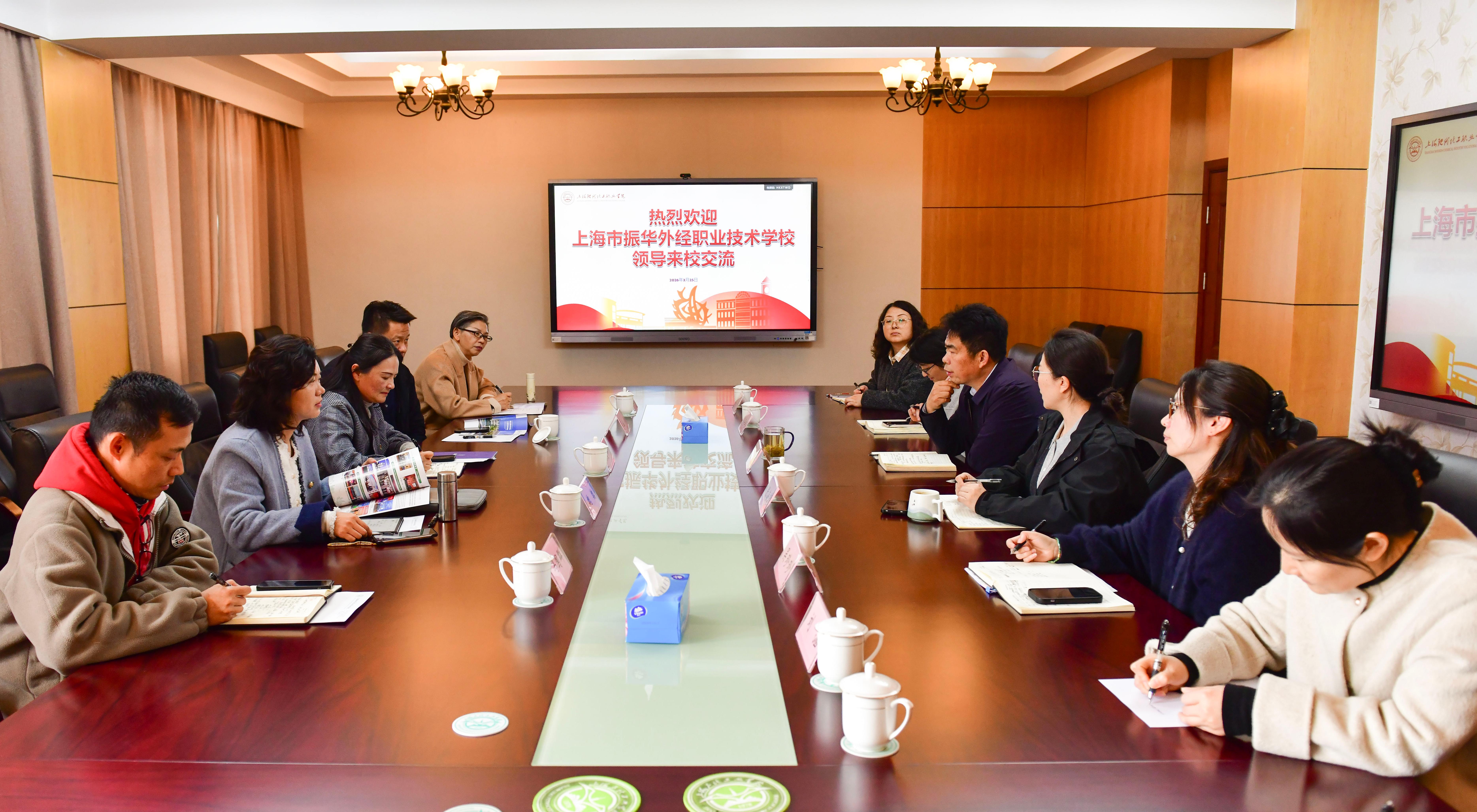
President Chen Xiaobin extended a warm welcome to Zhang Dongping and her delegation. He noted that vocational education is currently at a critical stage of deepening reform and pursuing high-quality development, and that collaborative education between secondary and higher vocational schools is a crucial step to enhance educational quality and align with industry demands. She provided a detailed overview of the school achievements in program development, training base construction, and industry-education integration, expressing the hope that both sides would leverage their respective strengths, deepen resource sharing, and jointly cultivate high-quality technical and skilled talent.
The discussions focused on the articulation model for the "Smart Livelihood Services" program cluster. The two parties conducted thorough deliberations on core issues such as the connection mechanism between secondary and higher vocational schools, curriculum system optimization, and the joint construction of training platforms. Zhang Dongping stated that Shanghai Zhenhua Foreign Trade Professional School places great importance on the partnership with Shanghai Modern Chemical Industry Vocational College. She expressed the hope that through this collaboration, both schools could enhance the professional capabilities of their teaching staff and the practical skills of their students, jointly serving the development of the city's smart livelihood services industry.
The meeting yielded positive outcomes, with both sides agreeing that the discussion lays a solid foundation for the cooperation between the two schools. In the future, both parties will further strengthen communication and collaboration to jointly explore new pathways for the high-quality development of vocational education, aiming to cultivate and supply more high-quality skilled talent to support regional economic and social development, and to better meet the demands of the smart livelihood services sector.