
On the afternoon of September 9, Vice President Huang Hanjun led a delegation from the Research Office to Jinshan Science and Technology Commission for a visit and discussion. The visit aimed to further deepen school-enterprise integration, effectively align the education, talent, industry, and innovation chains, and better serve the high-quality development of Jinshan’s leading industries—new chemical materials, intelligent mobility, and equipment manufacturing. Sun Pengli, Deputy Director of Jinshan Science and Technology Commission; Yu Danna, Section Chief of the Science and Technology Development Promotion Section; and Yang Ling, Director of the Science and Technology Innovation Center, attended the meeting.
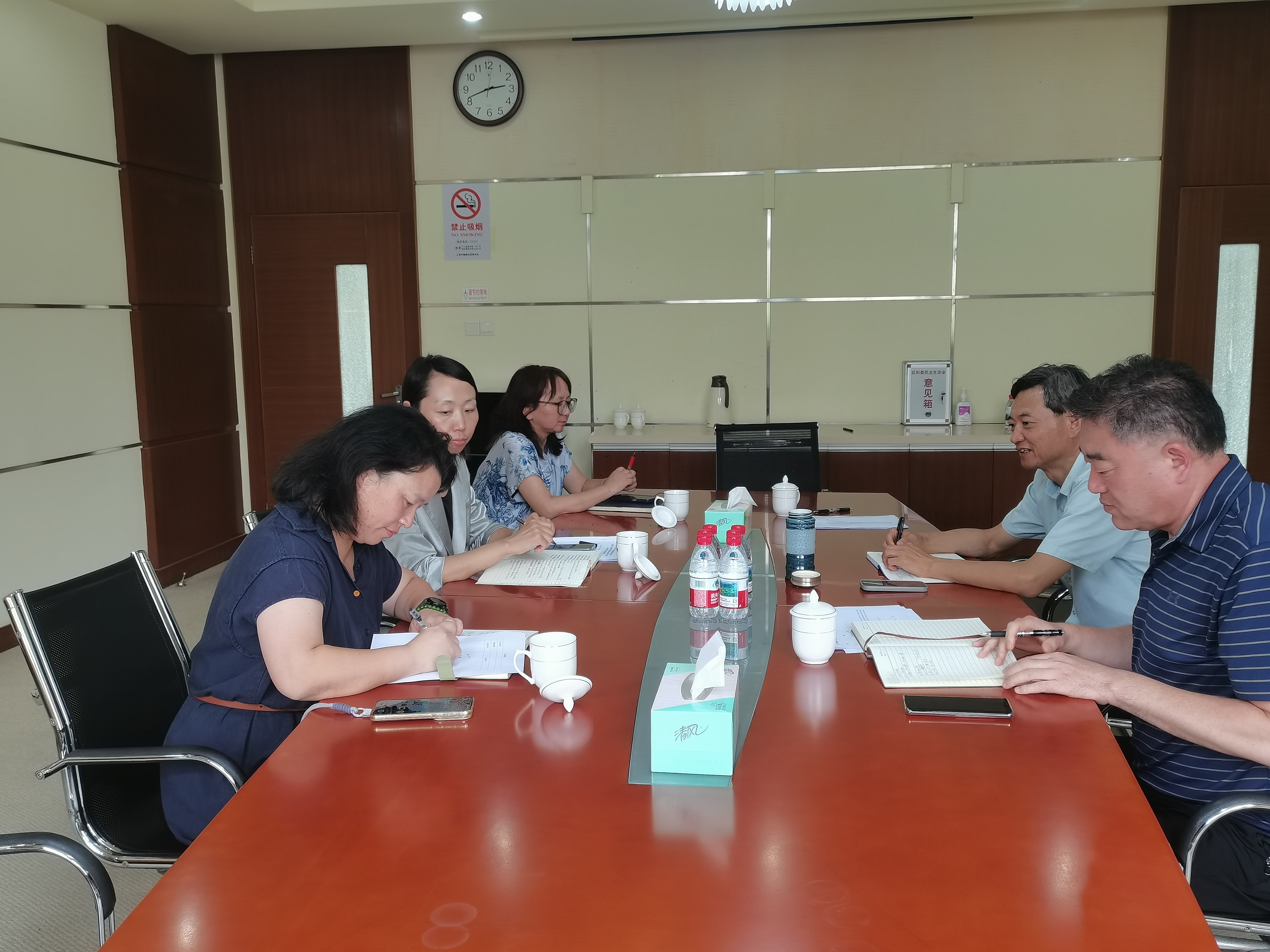
Huang Hanjun introduced the school’s core positioning in school-enterprise symbiotic development and its existing educational and research foundation. He said that the growth of vocational colleges is closely linked to regional enterprise development. The school must take root in Jinshan’s local industries, rely on regional industrial resources for its own development, and at the same time supply suitable talent and technical support to enterprises. The school has a solid talent pool to serve local industries. Benchmarking the industry-education integration experience of leading domestic vocational colleges, it has established four service sectors: chemical industry chain, intelligent manufacturing transformation, safety and emergency services, and travel and residential health and wellness. It has already engaged with enterprises in fields such as motor R&D and new material coatings, fully demonstrating the feasibility of serving local enterprises.
However, there are practical pain points in current school-enterprise engagement. Most faculty contacts with enterprises are individual and spontaneous, and there is no official unified matchmaking platform, making it difficult to achieve large-scale service effects. Some local enterprises are insufficiently aware of the school’s research service capabilities, and trust-building for cooperation takes a relatively long time. Some highly educated faculty are deeply engaged in classroom teaching and lack opportunities for frontline industry practice. Influenced by the previous secondary vocational education stage’s orientation toward further education, the school has a relatively weak foundation for deep engagement with local enterprises.
Huang Hanjun focused on promoting the innovative cooperation model of stationed PhD workstations. Under the model, the school forms technical teams led by PhDs and supported by master’s degree holders to station in enterprises according to their actual needs. More than 70% of the team members’ working time is spent at the enterprise conducting R&D and tackling key technical problems. The remuneration and performance pay of stationed personnel are fully covered by the school, while the enterprise is only responsible for work assessments and bears no staffing costs. Stationed PhDs can also leverage alumni and supervisor resources from universities to connect enterprises with higher-level technical research forces. The teams implement a regular rotation mechanism, which not only ensures the continuity of enterprise R&D but also helps faculty accumulate practical industry experience and turn frontline practice into classroom teaching materials, achieving a triple win of enterprise technological improvement, faculty capability growth, and teaching content innovation. In selecting enterprises, the workstation will give priority to startup and growth-stage enterprises that align with Jinshan’s industrial direction, face key technical challenges, and lack research strength. It will not engage large leading enterprises with mature R&D systems, thus ensuring precise and efficient allocation of research resources.
Sun Pengli detailed the district-level policy system related to industry-university-research cooperation. Jinshan Science and Technology Commission has established a special industry-university-research cooperation program; enterprises applying jointly with universities can receive government subsidies. It has built a technology supply-demand solicitation platform that continuously collects enterprise technical challenges and matches research resources to solve production pain points. Meanwhile, the school can apply to become a Shanghai Public R&D Service Platform. Enterprises using the platform’s equipment services can enjoy municipal and district voucher subsidies, and platforms with excellent performance can also receive municipal special awards.
Regarding follow-up implementation measures, both sides agreed to establish a regular school-enterprise matchmaking mechanism, using list-based information exchange as a starting point to open three-party communication channels. During enterprise visits, Jinshan Science and Technology Commission will simultaneously promote the school’s service resources; after confirming that an enterprise has genuine needs, it will invite the school to visit the enterprise together. The school will compile a list of faculty technical achievements and services and a list of shared equipment resources, and incorporate them into Jinshan Science and Technology Commission’s enterprise service resource database for distribution to enterprises across the district.
For the school’s internal implementation, the meeting specified that the school will complete the compilation of the two resource lists as soon as possible, clearly indicating service capability boundaries and testing qualifications to avoid commitments beyond its scope. It will organize PhDs and key faculty in chemical and intelligent manufacturing fields to hold a special deployment meeting to build consensus and implement school-enterprise collaboration tasks. It will establish regular communication channels, regularly update research achievements and service developments, and carry out solid preliminary research on enterprises and technical services.
This discussion further opened up the collaboration channel between the school and the local science and technology authority, marking a substantive step forward in the school’s school-enterprise symbiotic development. Going forward, Shanghai Modern Chemical Industry Vocational College will base itself on Jinshan’s industrial realities, fully unleash its talent and research advantages, and use projects such as stationed PhD workstations and the Sci-Tech Innovation Leading Class as drivers to remove bottlenecks in industry-university-research cooperation, bridge the “last mile” in translating research outcomes into enterprise application, and inject vocational education strength into Jinshan’s industrial transformation and upgrading, achieving mutual benefit and win-win results for the school, the locality, and enterprises.